
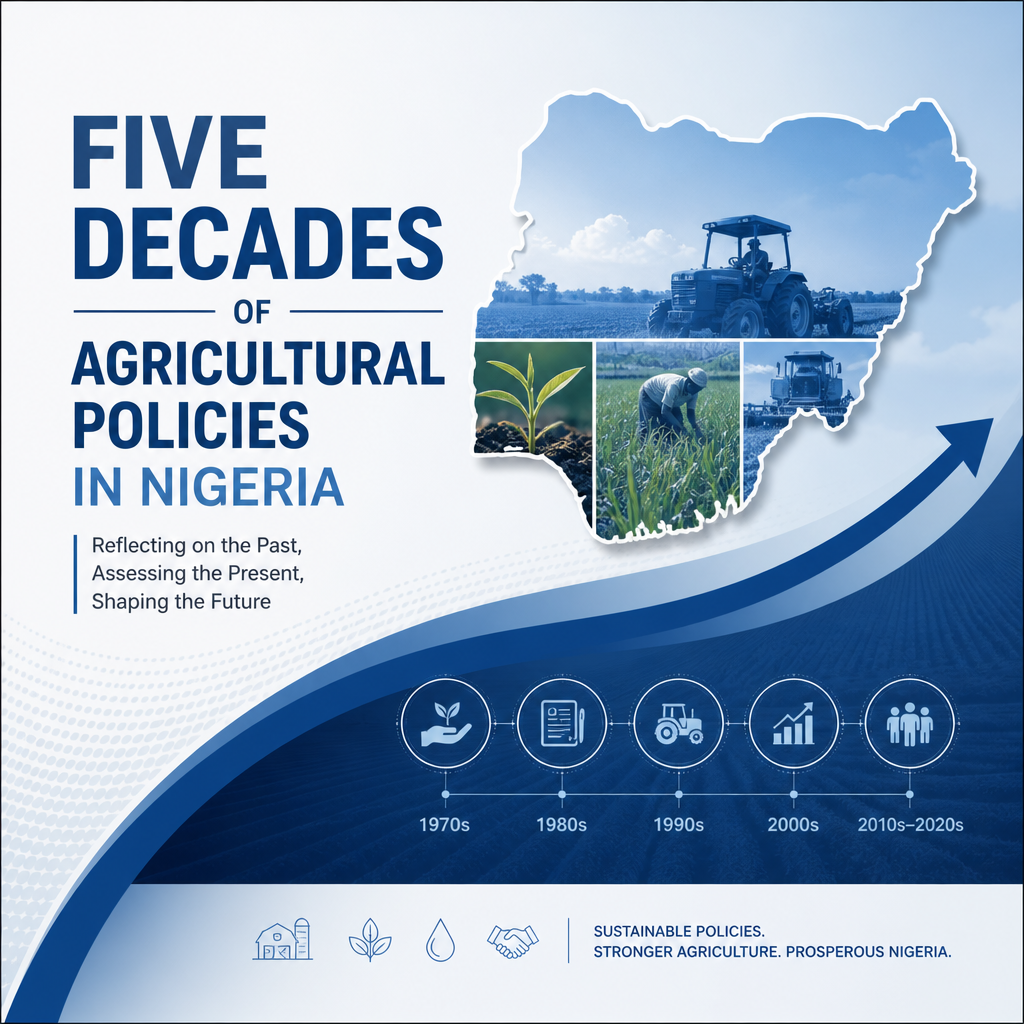
Five Decades Of Agricultural Policies In Nigeria
 Agriculture, Forestry & Fishing
Overview
This article, published in the CBN Bullion in 2008, examines the role of statistics in the formulation and implementation of agricultural policies in Nigeria over five decades since independence. The author, O. L. Akinboyo, a Principal Statistician in the Statistics Department of the Central Bank of Nigeria, argues that despite agriculture being intended as the main driver of economic growth, the sector has underperformed in terms of foreign exchange earnings and linkages with other sectors. He attributes this partly to inadequate planning and the lack of reliable, consistent statistics. The paper highlights the importance of food security, which is defined as a situation where the majority of the populace has access to domestically produced food at affordable prices. It notes that successive administrations from 1960 to date have implemented various food policies aimed at improving the sector. The author emphasizes that food policy is an integrated approach that involves not only agricultural production but also feeding industries, food processing and manufacturing, distribution and marketing, trade, and consumption. Agriculture is described as the major employer of labor and a key contributor to industrialization by providing food for the labor force, as a poorly fed worker cannot supply efficient labor. The article references President Umaru Musa Yar'Adua's Seven Point Agenda, which included Food Security and Agriculture as one of its pillars. The abstract mentions that publications of the Central Bank of Nigeria (CBN) and the National Bureau of Statistics (NBS) serve as veritable sources of data and reference materials on Nigeria. Without basic information on economic developments, policy makers would find it difficult to assess economic performance. The article appears to be part of a larger work, with the citation indicating it spans pages 35-44 of Volume 32, Number 4 of the CBN Bullion, published in October-December 2008. The document type is an article, likely a policy analysis or review, given its focus on agricultural policies and the role of statistics. The language is English. The author argues for adequate planning in terms of human and material resources, which cannot be divorced from adequate, reliable, and consistent statistics. The article seems to be cut off at the end, but the abstract and introduction provide sufficient content for a detailed summary. Key entities include the Central Bank of Nigeria, National Bureau of Statistics, President Umaru Musa Yar'Adua, O. L. Akinboyo, and the CBN Bullion. Dates mentioned include 2008 and the period from 1960 to date (2008). The main topics covered include agricultural policies in Nigeria, food security, the role of statistics in policy formulation, economic development, and the Seven Point Agenda. The article is classified as an article in terms of document type, and the language is English.