
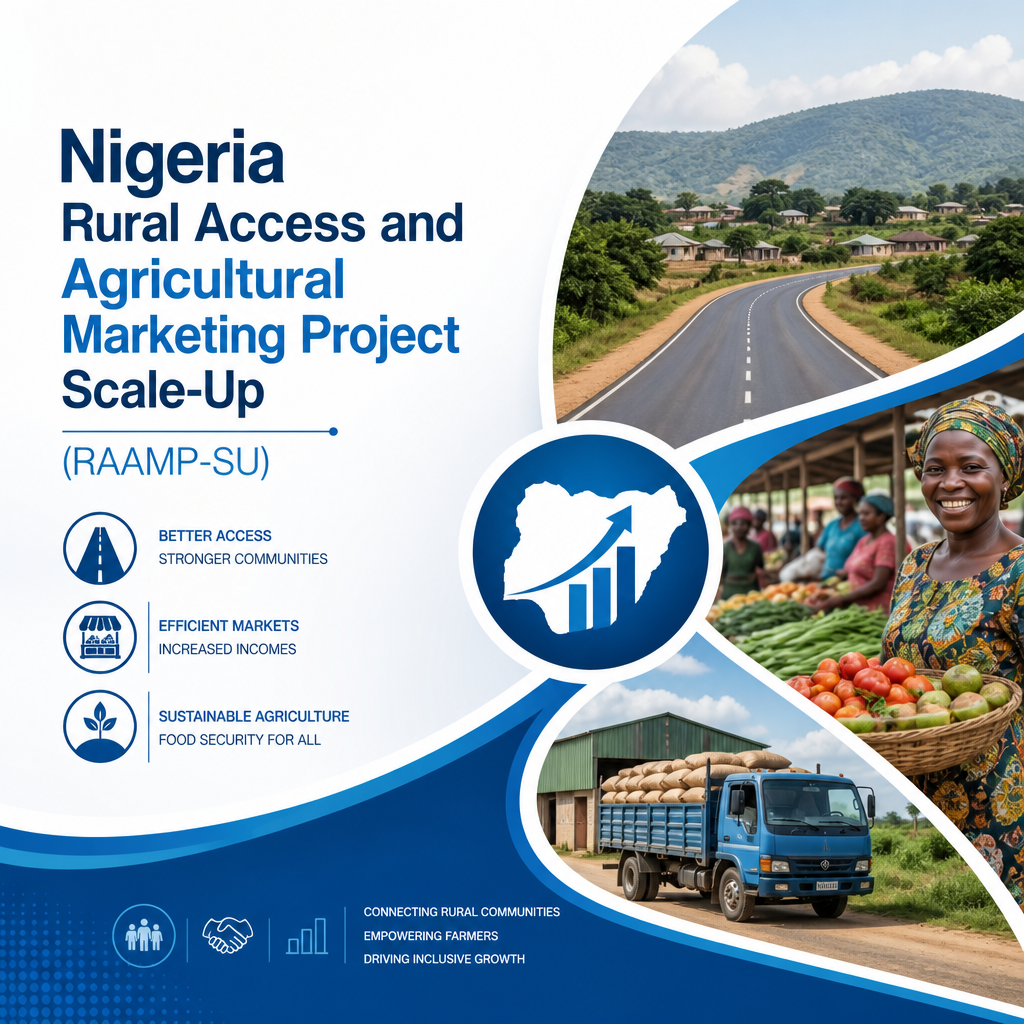
Nigeria Rural Access and Agricultural Marketing Project Scale-Up (RAAMP-SU)
 Agriculture, Forestry & Fishing
Overview
This document is the Stakeholder Engagement Plan (SEP) for the Nigeria Rural Access and Agricultural Marketing Project Scale-Up (RAAMP-SU), dated May 2024. The SEP is a comprehensive framework designed to guide effective engagement with stakeholders throughout the project's lifecycle. The document begins with an introduction that outlines the project background, components, and the objective and justification of the SEP. It highlights the envisaged benefits of the SEP and its applicability to the project. Chapter Two details the relevant laws and regulatory framework, including the Constitution of the Federal Republic of Nigeria (1999), the Freedom of Information Act (2011), the Public Complaints Commission Act (1975), the National Orientation Agency Act (2005), the Nigerian Environmental Impact Assessment Act, the Nigerian Urban and Regional Planning Act, and various Federal Ministry of Environment regulations and international guidelines. It also describes the administrative framework at federal and state levels, and the institutional arrangements for RAAMP-SU. Chapter Three focuses on stakeholder identification and analysis, categorizing stakeholders into project-affected parties, other interested parties, disadvantaged and vulnerable groups, and addressing gender mainstreaming. It includes stakeholder influence-interest mapping and a detailed stakeholder analysis. Chapter Four presents the Stakeholder Engagement Plan itself, outlining the SEP approach, stakeholders communication strategy, and the detailed engagement plan. Chapter Five discusses resources and responsibilities for implementing the SEP, covering resources, training, and budget. Chapter Six introduces the Grievance Redress Mechanism (GRM), monitoring, and reporting. The document is structured to ensure inclusive and transparent stakeholder engagement, aligning with national laws and international best practices. It emphasizes the importance of engaging disadvantaged and vulnerable groups, promoting gender equality, and establishing a robust grievance mechanism to address concerns. The SEP aims to foster collaboration, minimize conflicts, and enhance project outcomes by ensuring that stakeholders are informed, consulted, and involved in decision-making processes. Key entities involved include the Federal Republic of Nigeria, the Federal Ministry of Environment, the Federal Ministry of Agriculture and Rural Development, and various state-level institutions. The document is a policy-oriented report that serves as a guide for project implementation, ensuring compliance with regulatory requirements and promoting sustainable rural development.